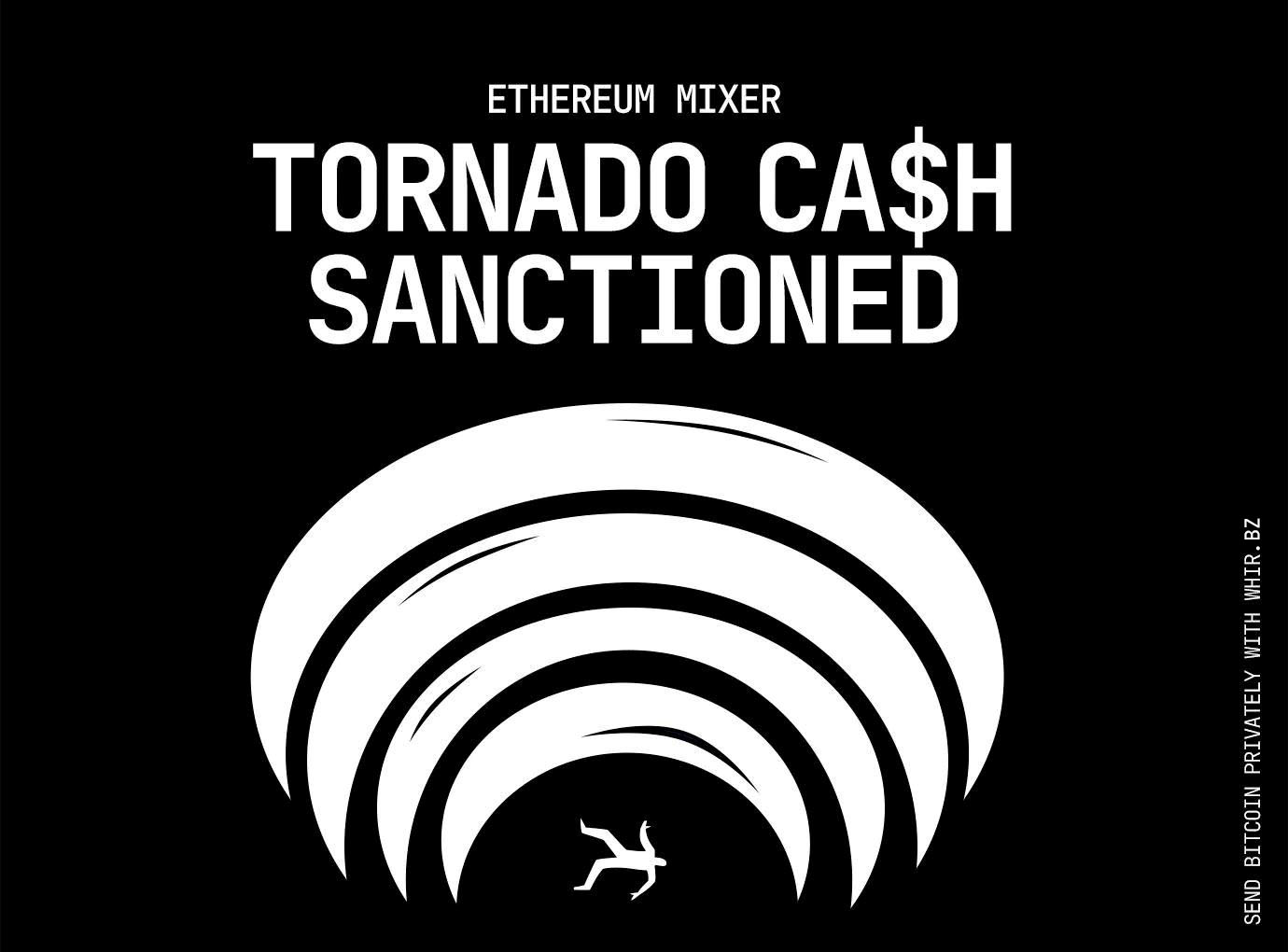
The U.S. Treasury sanctioned major Ethereum mixing tool Tornado.
Only fairly recently have we seen
probably one of the most important news connected to cryptocurrencies
and privacy come out. At the beginning of August, the U.S. Treasury
sanctioned Ethereum mixing tool Tornado Cash.
Through this step it essentially made usage of this tool completely illegal for any U.S. citizen.
However, the consequences of these sanctions are far more reaching than
just Tornado Cash. Many have already stated and shown that due to this
step, the U.S. Treasury has essentially violated freedom of speech. How?
That is what we will explore today.
Everything you need to know about Tornado Cash sanctions
Tornado Cash is an Ethereum mixing tool that provides services to all
the users who chose to do so without discrimination based on location. Tornado Cash has established itself as one of the most prominent mixing tools that was outside of the world of Bitcoin. It is estimated that over the years the total transaction volume connected to the platform topped more than $7.5 billion.
On 8th of August the U.S. Treasury with its agency’s Office of
Foreign Assets Control (OFAC) added Tornado Cash to the sanction list.
Moreover, OFAC also added about 45 addresses (current reported numbers
are 38 ETH addresses and 6 USDC addresses) to its Specially Designated
Nationals and Blocked Persons (SDN) list, essentially banning all
Americans and companies from interacting with the given addresses. Due
to this, not only the addresses but also the protocol’s website and its
associated smart contracts are blocked.
The U.S. Treasury stated that this was due to the repeated failure of
Tornado Cash to impose effective controls designed to stop it from
laundering funds for malicious actors. The statement from Treasury also said that it estimates that over $7 billion dollars was laundered through this tool, essentially classifying every transaction that took place through Tornado Cash as an attempt to launder money.
According to the official statement, this decision came about mainly
to stop North Korean criminals who are connected to the Lazarus Group
Axie Infinity hack worth $600 million. The supporters of this decision
believe that North Korean criminals connected to this hack have used
Tornado Cash to launder the stolen money through it. The investigation
by the FBI has been ongoing since April and hinted even before that
Tornado Cash might be subject to regulatory action.
Companies showing backs to Tornado Cash
Several cryptocurrency and technology companies were very quick to impose some controls in face of this new announcement.
For instance, Roman Semenov, one of the co-founders of Tornado Cash,
reported that GitHub, one of the most popular developer platforms,
suspended his GitHub account following the news. What is worrisome is
the fact that Semenov was not named in the Specially Designated National
list, yet got suspended from the platform anyways.
Circle, the issuer of the USDC stablecoin, was also fast to
react to the sanctions and blacklisted addresses on the given list
without any explanation. According to estimates this means that
the blacklisting of the USDC addresses will freeze an amount of about
$75 000 that belongs to Tornado Cash users.
Not everyone is on board
While this feels like a coordinated attack that was planned ahead,
not everyone is on board with this step. On the contrary, several
cryptocurrency companies and lobbyists have already expressed their
support for Tornado Cash and freedom of speech. As many noted, Tornado
Cash is nothing more than just a neutral tool (in the form of a written
code), which means that sanctioning it like this has no place in a free
society.
Semenov himself expressed his concerns immediately after being suspended by GitHub by asking a very simple question:
“Is writing open-source code illegal now?”
Many agree with his wondering. For instance, Jerry Brito, executive
director of Coin Center, stated that this step has nothing to do with
sanctioning the illegal actors or criminals. He specified:
“It is not any specific bad actor who is being sanctioned, but
instead it is all Americans who may wish to use this automated tool in
order to protect their own privacy while transacting online who are
having their liberty curtailed without the benefit of any due process.”
Jake Chervinsky, head of policy at Blockchain Association, also
believes that the U.S. Treasury has crossed a line with this step.
Nicholas Gregory, CEO of CommerceBlock has elaborated more on this topic
by stating that this step does not prevent criminals from continuing in
their illegal activities. He believes that criminals will be criminals
and will thus find a way to go around these measures.
“The ban on Tornado Cash makes little sense, because in the end, no
one can prevent people from using other mixer smart contracts or forking
the existing ones. It neither hinders cybercrime, nor privacy.”
Only a few weeks back has Tornado Cash officially announced that it
has fully open-sourced its user interface code. This was to move towards
the goal of complete decentralization and transparency.
Is using mixers illegal?
While Tornado Cash is predominantly an Ethereum mixer, the logic
behind the sanctions put forward can be simply connected to Bitcoin and
its mixers. If the U.S. Treasury or any other regulatory agency in the
U.S., or, in fact, around the world, does not like what the given tool
is doing, they can make it illegal.
Tornado Cash was nothing more than a tool itself. While it was used
for cryptocurrency mixing, which is associated with higher transaction
privacy, the regulators did not provide any concrete evidence of proving that Tornado Cash did indeed help with “laundering $7 billion.”
The morality of the cryptocurrency mixers, whether
they should be legal or illegal, is something that we have uncovered
previously. However, the main point of the wrongdoing of the regulators
is that they are essentially banning the tools they do not like and most
probably do not understand.
Tornado Cash, just like any other cryptocurrency mixer,
is just a software, a neutral tool. A tool just like a phone, car or
internet in the essence that it does not inherently do anything good or
bad, right or wrong. It only provides services that the users can
exploit in any way they want.
Thus, it cannot be stated overall whether this tool is good or bad.
Just like one cannot state that with a phone, car or internet. All of
these tools are used daily not only for positive things, but also for
negative. The same logic can be applied to mixers.
Conclusion
One of the most popular Ethereum mixers is thus in serious trouble in the United States. But
so is the freedom of speech, since tools such as Tornado Cash are
nothing more than a code, which should be considered speech.
If you do not want to dabble into Ethereum and many tokens built around it, but want to still maintain financial privacy which is a crucial human right, feel free to use Whir to send Bitcoin privately.
––
If you liked this article, please share it on Twitter.
Disclaimer:
This article does not serve as a piece of financial advice or
encouragement and inducement for the usage of Bitcoin and other
cryptocurrencies. Its primary role is informative, explanatory, and
educational. The readers have to decide themselves whether to use or not
to use these types of services.